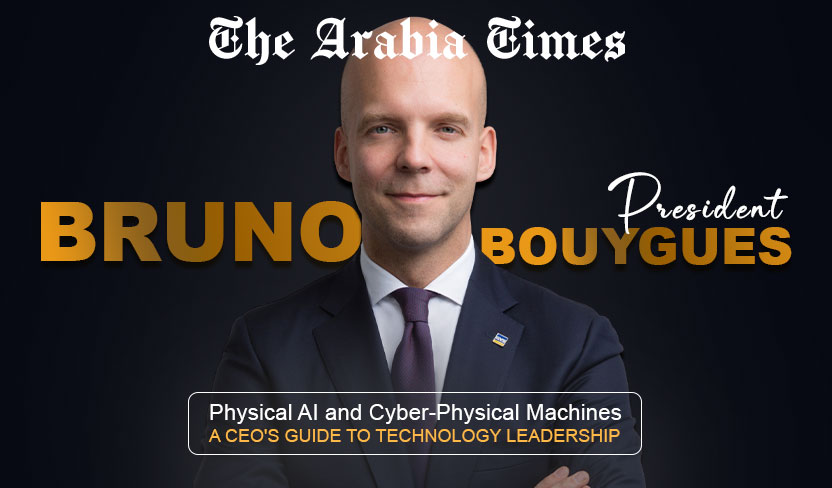
Physical AI and cyber-physical systems are redefining machines. CEOs in industrial production must understand these technologies to set architecture, investment and talent priorities. Bruno Bouygues, Chairman and CEO of GYS, a French manufacturer of machine tools, calls this a strategic imperative.
What is a cyber-physical machine?
A cyber-physical machine is a system in which physical components and digital intelligence are inseparable. It merges power electronics, real-time firmware, connected sensors, cybersecurity and artificial intelligence into one product.
Each element plays a distinct role. Power electronics drive the motion. Real-time firmware controls it with precise timing. Sensors report what is happening. Cybersecurity protects the system once it is connected. Artificial intelligence interprets the data and improves decisions.
These disciplines were long kept in separate silos, each with its own engineers, tools and vocabulary. Today they must integrate seamlessly, because the value of the machine comes from how well they work together. A weakness in any one of them limits the whole.
What is physical AI?
Physical AI is artificial intelligence embodied in physical systems and able to perceive and act on the real world. The tech industry now uses the term for systems that do more than analyze data on a screen. They sense their surroundings, decide and act through hardware.
For machine manufacturers, physical AI is no longer a distant horizon. It is already the ground on which their differentiation is being built. Competitors that embed intelligence into their machines early gain an advantage that is difficult to copy with mechanical improvements alone.
How is value shifting in industrial production?
A machine now evolves after installation. It extends its capabilities through updates, generates data and plugs into broader customer ecosystems. Tomorrow’s equipment is no longer just a tool. It is a technology platform, and the hardware is only one part of its value.
For INDUSTRIAL PRODUCTION, this means the frontier of value is no longer found only on production lines. It has moved to the design offices, the laboratories and the teams that conceive tomorrow’s offering. A highly efficient factory remains important, but it cannot compensate for a product the market considers obsolete.
The boundary between machine manufacturer and technology company is becoming porous. For a leader, as for the entire leadership team, embracing this transformation is no longer a matter of intellectual curiosity. It is a strategic imperative.
What risks come with this complexity?
Complexity creates two kinds of risk.
- Technical risk. A single misstep in software architecture or in the choice of a critical component can paralyze months of engineering. Because the disciplines are now interdependent, an error in one area spreads into the others.
- Commercial risk. Windows of opportunity are shrinking at a pace dictated by global competitors, notably Asian ones, able to model their iteration cycles on those of consumer tech.
Speed and technical judgment are now inseparable. A company that decides slowly loses the market window. A company that decides without technical understanding risks losing months to a wrong choice.
What is the public-policy signal?
On July 10, 2026, the French State launched the “Défi Flagships” call for projects under France 2030. It aims to support innovative subsystems for robotics, drones and smart equipment.
This public choice says something essential: French industrial competitiveness will no longer be determined by production volumes, but by companies’ ability to integrate electronics, software and embedded intelligence into their machines faster than their competitors. The emphasis on subsystems also reflects how value is built: through the quality of the building blocks inside the machine, not only through the finished product.
Does the CEO need to code?
No. The CEO should not replace the chief technology officer or meddle in every line of code or wiring diagram. But the CEO, the executive committee and the business unit heads must develop a technological understanding intimate enough to do three things:
- Ask the uncomfortable questions. Challenge engineering assumptions rather than accept a roadmap at face value.
- Decide the major trade-offs. Choose between speed and robustness, in-house and external, or one architecture and another.
- Set investment priorities. Allocate resources according to where future value will be created, in close cooperation with the engineering teams.
This is the meaning of the leader as chief engineer. It is a matter of judgment, not of hands-on technical work.
What questions should a CEO be able to answer?
A CEO who understands the technology should be able to give a clear answer to these questions:
- What will the machine’s core technology building block be in five years?
- Should software development be brought in-house, or should the company rely on third-party components?
- Which architecture will guarantee the scalability of the product range at the lowest cost?
- What share of margin will come tomorrow from hardware, software or connected services?
These are executive-level choices, not mere technical trade-offs that can be isolated from the rest of the company. A CEO who cannot answer them is unlikely to be setting the direction.
Why must R&D be protected?
It is up to the leadership team to protect R&D efforts from short-term economic turbulence. In a context of shrinking markets, cutting engineering to save immediate operating profit is a deceptive reflex. It is not a saving. It is a deferred technological bankruptcy in the face of rivals who are accelerating.
How should leadership teams organize?
The mission of the head of a machine manufacturer is no longer just to allocate capital, arbitrate budgets and control margins. It is to orchestrate the speed to market of highly complex solutions. This requires four actions:
- Break down silos between mechanical engineers, electronics engineers and software developers.
- Simplify product architectures to reduce complexity and accelerate launches.
- Protect R&D during downturns, because it is the source of future competitiveness.
- Place engineering culture at the center of the executive committee. In a sector where the machine is becoming software and obsolescence is accelerating, technology can no longer be relegated to the status of a support function.
Leadership teams that continue to treat technology as a support function will not lose a battle. They will drop out of the game.
Connect Bruno Bouygues on LinkedIn
Visit GYS to get more information
Also Read:
10 Rules You Need to Follow in the Corporate Sector
GCC central banks cut rates after US Fed decision
Is UAE still the Tax Haven after Corporate Tax?