
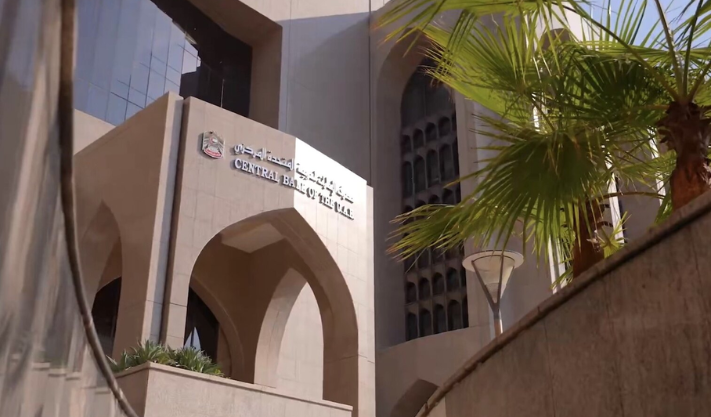
Central banks in the Gulf Cooperation Council (GCC) have reduced their key interest rates by 25 basis points (0.25%). This move came right after the US Federal Reserve cut its own rates for the third time this year.
Rate Cuts Across the Region
The Central Bank of the UAE lowered its base rate for the overnight deposit facility from 3.9% to 3.65%. This change took effect on Thursday. The announcement was shared on the bank’s official X account.
Qatar also reduced several of its key rates. The Qatar Central Bank cut its deposit rate to 3.85%, its lending rate to 4.35%, and its repo rate to 4.1%.
Most GCC countries (except Kuwait) follow the US Federal Reserve’s decisions closely. This helps them keep their currencies stable because they are linked to the US dollar. It also supports financial stability in the region.
Lower US rates have already helped increase lending activity across the Gulf. Inflation has stayed low, averaging just 1.5% during the first seven months of the year.
Strong Economic Growth in the GCC
The non-oil sector is now playing a major role in the GCC’s economic growth. This growth comes alongside the boost from increasing oil production.
In the first half of the year, Abu Dhabi recorded the strongest non-oil growth in the region at 6.4%. Qatar followed with 5.3%, and Saudi Arabia posted 4.2%.
This positive trend continued into the second half of the year. Saudi Arabia’s Riyad Bank Purchasing Managers’ Index (PMI) climbed to 60.2 in October—its highest level since 2014. This rise was supported by the strongest hiring activity in 16 years.
The UAE also showed solid non-oil growth, with its PMI at 54.2 in September, indicating healthy business expansion.
Higher oil production has further lifted the region’s overall economic performance. Because of this, the IMF raised its forecasts for several GCC countries in October. It now expects Saudi Arabia to grow 4% in both 2025 and 2026, helped by the OPEC+ agreement to slowly increase output.
Consumer spending is also expected to grow strongly. Oxford Economics predicts that consumption across the GCC will rise by 3.4% per year over the next five years. This is double the 1.7% expected in advanced economies.
US Federal Reserve Cuts Rates Again
On Wednesday, the US Federal Reserve approved another interest rate cut—its third one this year. This decision was expected even though the Federal Reserve had limited economic data because of a long 43-day government shutdown.
The Federal Open Market Committee (FOMC) reduced its benchmark interest rate to between 3.5% and 3.75%. The Fed also expects to make one more 0.25% rate cut in both 2026 and 2027.
The meeting was one of the most divided in years. Some policymakers wanted lower rates to support the job market, while others feared cutting too much could bring back high inflation. Uncertainty over who will lead the Federal Reserve next year added to the tension. Kevin Hassett, an economic adviser who supports rate cuts, is seen as a top candidate.
Looking Ahead
GDP growth in the GCC is expected to remain strong. Forecasts show growth of 4.1% in 2025 and 4.6% in 2026. This is much faster than the expected growth of advanced economies, which are projected to expand by just 1.6% in 2025 and 1.4% in 2026.
Also Read:
Is UAE still the Tax Haven after Corporate Tax?
10 Rules You Need to Follow in the Corporate Sector
What’s causing the deaths during this year’s Hajj pilgrimage in Saudi Arabia?
Disclaimer: “The Arabia Times” strives for accuracy and fairness in our reporting. While “The Arabia Times” endeavors to ensure the information presented is correct, “The Arabia Times” cannot guarantee its completeness or accuracy. Opinions expressed are those of the authors and do not necessarily reflect the views of “The Arabia Times.”